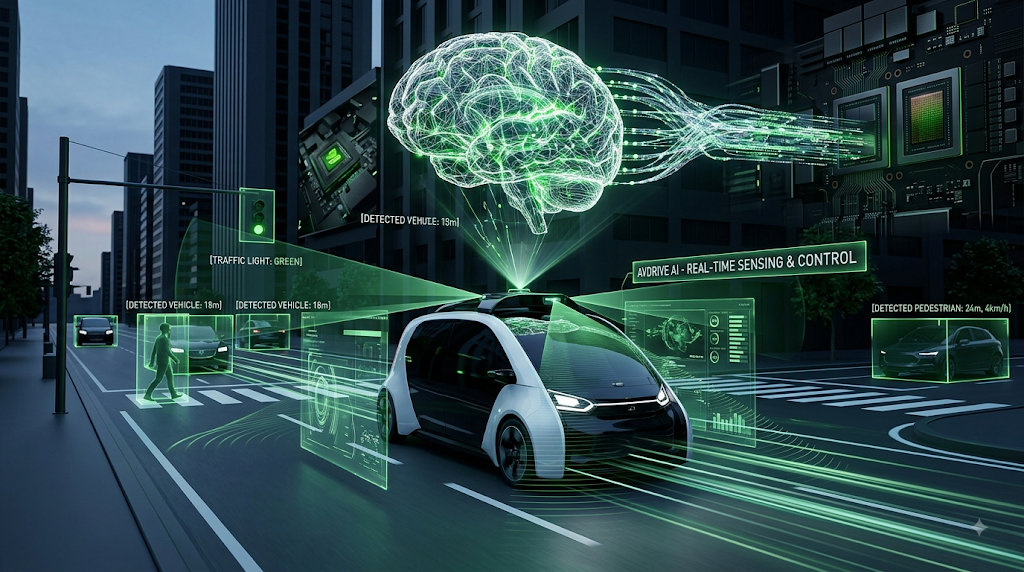
Watching autonomous vehicles on the road often brings up a curious question: How exactly do these cars see the road ahead, assess risks, and decide to brake or change lanes?
Until now, autonomous driving technology has primarily focused on recognizing surroundings using information from various sensors like cameras, LiDAR, and radar, and driving according to pre-programmed rules.
However, there is a recent movement pushing autonomous driving AI to the next level. This comes as Nvidia has unveiled a new inference-based AI model designed for robotaxi and autonomous vehicle developers: the NVIDIA Alpamayo 2 Super.
What is Nvidia's Alpamayo 2 Super?
Alpamayo 2 Super is not an AI that simply recognizes what is in front of the car. It is a Vision-Language-Action (VLA)-based reasoning model that understands the surrounding situation, determines how to move forward, and connects these decisions to actual driving behavior.
When announcing this model in May 2026, Nvidia described it as an open AI model that supports the development of robotaxis and Level 4 autonomous driving.
| Category | Alpamayo 2 Super |
| Model Type | Inference-based VLA Model |
| Scale | 34 billion parameters |
| Primary Purpose | Development of autonomous driving and robotaxis |
| Input Information | Video, vehicle movement data, etc. |
| Key Functions | Recognition, Reasoning, Planning, Action |
| Application Field | Level 4 autonomous driving development |
| Features | Open model and development tool ecosystem |
🟨 The core takeaway is that the AI goes beyond simply "seeing" the surroundings; it takes charge of "judging and acting" upon the situation.
How Does it Differ from Existing Autonomous Driving AIs?
The most challenging aspect of autonomous driving is dealing with unexpected situations. Scenarios like an obstacle suddenly appearing on the road, the car in front stopping abruptly, or a pedestrian moving in an unexpected direction are difficult to adequately include in training data. This is known as a "long-tail situation."
While human drivers synthesize surrounding information to make judgments in these situations, it represents a significantly difficult problem for AI. Alpamayo was developed specifically to leverage reasoning capabilities in these complex scenarios.
The Car Explains "Why It Made That Decision"
What particularly stands out in this technology is its reasoning capability.
Imagine an autonomous vehicle suddenly slowing down. In existing systems, while we can confirm the resulting deceleration, the decision-making process might be difficult for a human to understand. Conversely, an inference-based model is designed to make judgments based on causal relationships, such as:
- Movement of the vehicle ahead
- ↓ Pedestrian's location
- ↓ Road conditions
- ↓ Probability of a collision
- ↓ Necessity to decelerate
🟨 Understanding the AI's decision-making process in autonomous driving goes beyond mere convenience; it holds profound significance for safety verification.
A Large AI with 34 Billion Parameters
Alpamayo 2 Super is a massive inference model utilizing 34 billion parameters. Here, parameters refer to the numerous internal weights used during the AI's process of learning and judging information.
While a larger model isn't unconditionally better, a powerful model plays a crucial role in autonomous driving, which requires understanding complex videos and vehicle movement data simultaneously while reasoning through diverse situations.
However, this doesn't mean this exact model will be directly installed in regular cars to handle all decisions. Systems integrated into actual vehicles require a separate optimization process that considers performance, power consumption, latency, and safety.
Nvidia Didn't Just Release a Single Model
The more significant part of this announcement isn't just Alpamayo 2 Super itself. Nvidia is expanding an entire ecosystem that supports the complete autonomous driving development process.
| Technology | Role |
| Alpamayo 2 Super | Autonomous driving inference and action model |
| AlpaGym | Closed-loop reinforcement learning |
| Cosmos-Dreams | Autonomous driving scenario generation |
| Omniverse NuRec | Reconstructing real data into 3D environments |
| Physical AI Dataset | Training data for autonomous driving AI |
| CoC Auto-Labeling | Automatic labeling of driving data |
In other words, they aim to connect the entire development cycle into a single ecosystem:
- Creating data
- → Training the AI
- → Testing in a virtual environment
- → Retraining based on incorrect judgments
- → Applying it to real-world vehicles (NVIDIA Newsroom)
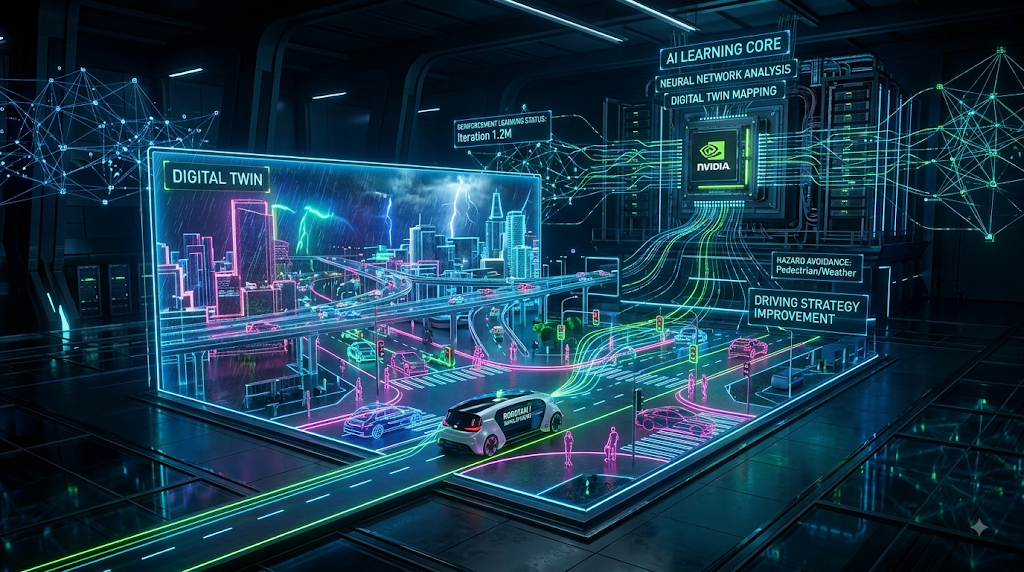
A Point of Focus: "Virtual Driving Tests"
Testing autonomous driving AI exclusively on real roads is both dangerous and expensive. Therefore, the process of testing by simulating diverse situations in virtual environments is critical. For example, the AI can be made to repeatedly experience scenarios such as:
- Pedestrians darting out unexpectedly
- Severe weather conditions
- Complex intersections
- Unpredictable vehicle movements
- Emergency situations right before a potential accident
Nvidia's Cosmos-Dreams generates autonomous driving environments that closely resemble reality, while AlpaGym allows the AI to learn based on the outcomes of its own driving decisions within these environments. (NVIDIA Newsroom)
Why Does Open Source Matter?
Another aspect worth noting in this announcement is the "open ecosystem."
Historically, autonomous driving technology has required massive development costs, data, and manpower. High-performance autonomous driving systems were particularly difficult to develop unless you were a car manufacturer or a massive tech company.
However, making AI models, data, and simulation tools publicly available broadens the path for developers and research institutions to innovate based on this foundation.
🟨 The competition in autonomous driving technology is likely to shift from "who will build everything from scratch" to "who can faster evolve open AIs and apply them to actual vehicles."
Will Robotaxis Become a Reality Sooner, Then?
The robotaxi market is already transitioning into a real-world service phase. In the US, commercial services utilizing unmanned autonomous vehicles are expanding, and by 2026, several companies are competitively scaling up their robotaxi operations. (Reuters)
In this context, the emergence of a platform that accelerates autonomous driving AI development could make market competition even fiercer. It is especially attractive for automakers and robotaxi companies, as it reduces the burden of developing AI models from the ground up, allowing them to refine their systems by integrating their own driving data.
However, "Fully Autonomous Driving" is Still Difficult
There is one caveat here. Just because an AI model demonstrates excellent reasoning capabilities doesn't mean perfect autonomous driving is immediately achievable. Real-world roads are full of variables. Diverse situations must all be accounted for, including:
- Sensor errors
- Weather changes
- Unpredictable pedestrian behavior
- Road construction
- Vehicle breakdowns
- Communication issues
Furthermore, safety verification and regulatory hurdles on actual roads must be resolved.
🟨 While the unveiling of Alpamayo 2 Super is a significant milestone in the advancement of autonomous driving technology, it is still too early to consider the era of fully autonomous driving complete.
How Will Autonomous Vehicles Change in the Future?
Future cars will likely evolve beyond merely processing sensor data toward a direction where AI truly understands and judges situations.
Much like human driving, it won't just stop at recognizing, "There is a car ahead," but will judge the cause and effect together, such as, "The car in front is suddenly slowing down, so I need to reduce my speed as well."
Applying this level of reasoning to autonomous driving AI will significantly enhance its ability to cope with complex road conditions.
Conclusion
It would be an understatement to view Nvidia's announcement simply as "a new autonomous driving AI model has been released." The more profound change is that the very method of developing autonomous driving AI is shifting.
By connecting:
- AI models
- Real-world driving data
- Simulations
- Reinforcement learning
- Automated data generation
...into a single ecosystem, an environment is being created where developers can experiment with and improve autonomous driving technologies much faster.
In the future autonomous driving market, crucial competitiveness might not only lie in manufacturing cars well, but in how quickly one can train a smart, safe AI and deploy it onto real roads. It is worth watching how far Nvidia's Alpamayo will transform the robotaxi and autonomous driving markets going forward.


