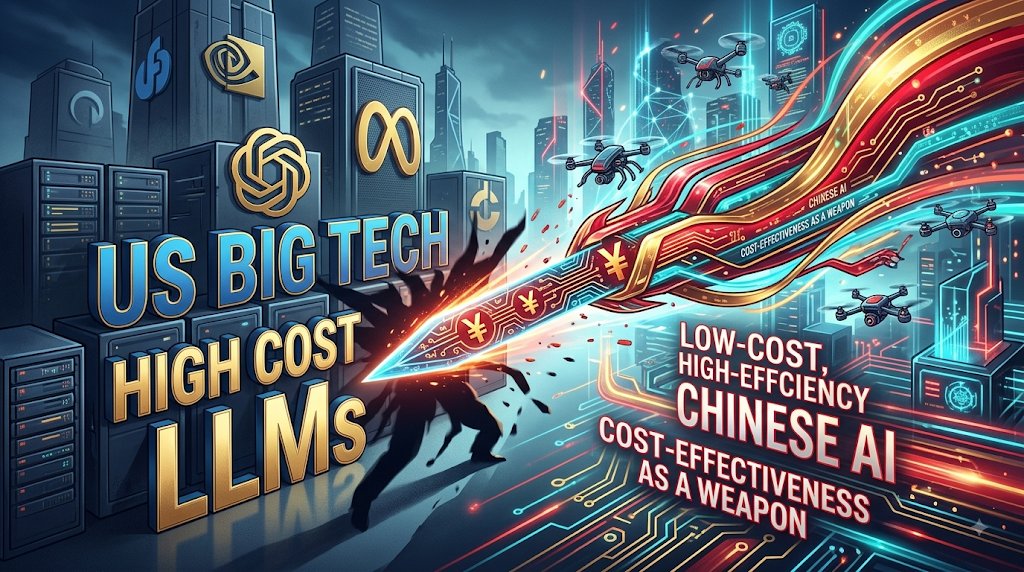
Until now, the global AI market has been dominated by Large Language Models (LLMs) centered around US Big Tech. Models with overwhelming performance like OpenAI's GPT-4 and Google's Gemini have led the market.
However, the dynamics of the AI market are shifting completely. We are transitioning from an era of seeking "unconditionally smart AI" to one that demands "practical and affordable AI." At the center of this shift is the fierce counterattack of low-cost, high-efficiency AI from China.
1. Why "Cost-Effective AI" Now?
When AI technology first emerged, companies cheered for its performance. But when they actually tried to implement it in the field, unimaginable operating costs (API usage fees, server maintenance, etc.) became a major obstacle.
"It's smart, but way too expensive!"
Companies have now begun to strictly evaluate whether their AI investments are generating returns (ROI, Return on Investment). Rather than blindly using the highest-performing chatbots, they are demanding efficient models that can deliver over 90% of the performance at a much lower cost.
2. DeepSeek and Kimi: The Powerhouses of the Mainland
Chinese open-source AI models are tenaciously capitalizing on this shift in market trends.
- DeepSeek: Despite US sanctions, it has introduced a highly cost-effective model that maximizes resource efficiency. By achieving GPT-4 level performance while pricing its API significantly lower, it has garnered an enthusiastic response from global developers.
- Kimi K3: Specialized in processing massive amounts of text (ultra-long context), this AI boasts high-efficiency performance, analyzing hundreds of pages of documents or code at once for a fraction of the cost.
The most formidable aspect of these models is that they are available as open-source or ultra-low-cost APIs, allowing even startups or small-to-medium enterprises with limited budgets to adopt them without a heavy financial burden.
3. A Paradigm Shift in the AI Market: From 'Performance' to 'Price & Efficiency'
The rise of low-cost Chinese AI is sending several crucial messages to the global AI ecosystem:
- Cracks in the Monopoly: US Big Tech companies can no longer monopolize top-tier AI technology.
- Advancements in Model Distillation: As technologies to train large models and shrink them into smaller ones advance, it is now possible to generate answers comparable to existing massive AIs with significantly less computing power.
- Companies Focusing on Practicality: Companies that previously paid expensive subscription fees are accelerating their transition to "in-house AI" by deploying cost-effective open-source models on their own private servers.
💡 Conclusion: Accelerating the Democratization of AI
Just like computers and smartphones before it, AI is moving from being an expensive "luxury item" to an accessible "everyday necessity." The counterattack of low-cost Chinese AI is putting pressure on US Big Tech to lower their prices, ultimately creating an opportunity for users worldwide to utilize AI more affordably.
All eyes in the IT industry are now on this unfolding "war of cost-effective AI" to see which technology will ultimately establish itself as the global standard.
'News' 카테고리의 다른 글
| [AI 트렌드] "가성비가 무기!" 미국 빅테크 위협하는 중국발 저비용 고효율 AI의 반격 (0) | 2026.08.13 |
|---|---|
| Nvidia Unveils Autonomous Driving AI? The Game-Changer for Robotaxis: ‘Alpamayo 2 Super’ (0) | 2026.08.12 |
| 엔비디아가 자율주행 AI를 풀었다? 로보택시 판도를 바꿀 ‘Alpamayo 2 Super’ (0) | 2026.08.12 |
| Cameras in AirPods? How Apple’s 2026 Innovation Could Change Our Daily Lives (0) | 2026.08.07 |
| 에어팟에 카메라가 들어간다고? 애플의 2026년 신기술이 바꿀 일상 (1) | 2026.08.07 |


